Category: Media Coverage

Articles about Branon Maple and other notable mentions

  • We’re Ready and Willing to be Your Wholesale Partner

    We’re Ready and Willing to be Your Wholesale Partner

    A Sweet Partnership

    As the calendar turned to 2025 and we finished our end-of-year paperwork, we noticed a small detail on a receipt we were moving from one file to another: One of our wholesale customers has been buying bulk maple syrup since 2001. That gave us pause — for 24 years, we’ve been bringing our maple syrup to this commercial bakery, a partnership we’re fiercely proud of.

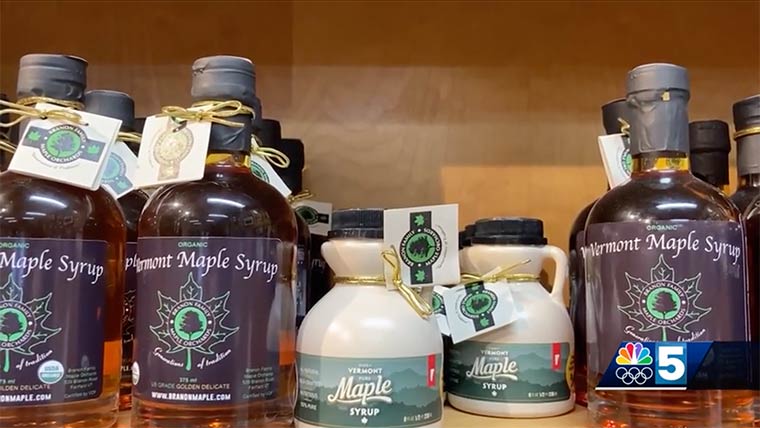
    It also motivates us. At Branon Family Maple Orchards, we work hard to deliver the best price for Vermont maple syrup. Today, our retail price is well below the average $57.10 per gallon trend the USDA reports. Our wholesale price of maple syrup is also below the national average, and we’re confident we can help other small businesses save money when they buy maple syrup.

    “It does seem like the price of all food is on a steep rise,” said Cecile Branon, who coordinates the wholesale program. “If we can save somebody money on their maple, hopefully, that lessens what has to be passed on to the consumer.”

    Can Branon Family Maple Orchards be your wholesale supplier of Vermont maple syrup? We think so. Here’s why…

    Our Bulk Customers

    Through the decades we’ve been in business, we’ve seen a wide array of other small companies buying wholesale maple syrup from us. In addition to the artisan bakery that’s been with us for nearly a quarter of a century, we sell to cafes (if you’re ever in Sonoma, CA., consider brunch at Sunflower Cafe), restaurants, coffee shops (try a maple latte from Kestrel Coffee in Burlington, VT) and specialty food producers.

    The fact that our syrup is certified organic and comes from Audubon-certified bird-friendly forests is important to other food producers who deliver delicious products that are sustainably sourced.

    Getting It To You

    Maple syrup is heavy. A gallon weighs about 11 pounds. Shipping looms as one of the biggest challenges all maple producers have. We’ve tried many cost-saving ways to ship maple syrup to our wholesale customers, and we’re still creatively exploring all kinds of alternatives.

    So, how do we get it to you? Well, it depends.

    Some customers need only a few gallons a month. We monitor shipping rates and dates to ensure we keep costs to a minimum. Typically, once a business develops a rhythm, FedEx Ground is the most effective and less expensive way to ship syrup.

    We can deliver to customers in northwestern Vermont. For instance, our long-running bakery customer prefers reusable 5-gallon jugs, so we fill them up, secure them in the back of our pickup and deliver them to the loading dock.

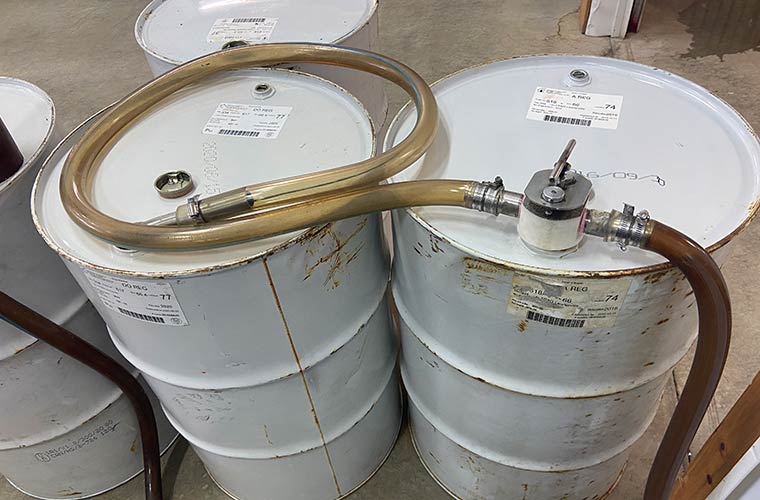
    Some customers require more than 5-gallon jugs. We also sell syrup by the 55-gallon barrel, which requires working with OTR truckers. We have experience in that, having trucked our syrup across the United States.

    Not Just Syrup

    While Vermont maple syrup is the core product in our customized wholesale program, everything we make can be bought at wholesale prices. We’ve found our granulated maple sugar, maple cream, and vinegars are of interest to many bakeries, restaurants, and specialty food producers.

    Let’s Work Together!

    While some minimum orders may be required, we promise we will work with you to create a package that meets your exact wholesale and food service needs. And we will work closely with you to find the most affordable shipping alternatives for getting you bulk maple syrup (or other products).

    So, let’s talk about how we can meet your wholesale syrup needs. Drop us an email or call us at 802-827-3914.

    We hope to start a long-term partnership with you, too!

  • As Vermont Maple Fest kicks off, local sugar makers reflect on an unusual tapping season

    As Vermont Maple Fest kicks off, local sugar makers reflect on an unusual tapping season

    “It’s been a weird year, but I think it’s been overall, production has been great,” said Cecile Branon, owner of Branon Family Maple Orchards.

    The 54th annual Maple Festival kicks off in Saint Albans Friday. The three-day event draws thousands to Vermont to celebrate local sugar makers.

    Cecile Branon is a co-chair for Maple Fest and a sugar maker who’s spent decades in the industry.

    Branon and her husband have run Branon Family Maple Orchards for 40 years. She said it was a pretty small operation when they first bought the orchard in 1984.

    “We started out with about probably 7,000 taps, maybe. And we used to gather them by buckets with horses,” Branon said.

    Now the team hand taps around 90,000 maple trees each year. But, Branon said growth has also come with some challenges.

    “Last year was a year nobody wanted to remember,” she said.

    An unexpected early warm up last year left many Vermont sugar makers missing out on a large part of the tapping season. It usually begins around February and March, but Branon said this year, she made sure to be ready early.

    “Our first boil here we started tapping the first of December and our first boil was the week before Christmas,” she said.

    And now that the season is wrapping up, she said planning has paid off.

    “It’s been a weird year, but I think it’s been overall production has been great,” Branon said.

    Anson Tebbetts, Vermont’s secretary of agriculture, said many maple makers around the state had similar experiences, finding more success by starting early this year.

    “They do not want to miss that first run because there’s sort of hit or miss whether the weather is going to cooperate or not,” he said.

    Tebbetts added a few early spring snowstorms also helped.

    “[They] really slowed things down. It was getting too warm, we didn’t have a lot of snow cover. So, I think that probably saved the season for a lot of folks,” Tebbetts said.


    Originally published on NBC5.

  • Tapping Into The World of Maple Vinegar

    Tapping Into The World of Maple Vinegar

    Every year, in late winter, 100-foot maple trees are tapped across the northeast and sap begins to flow through mainlines into a network of tubes, further into sugar houses and into large pots where it’s cooked to deep, amber confection. Every year over four million gallons of maple syrup are made across the US, part of a $100 million dollar market — and a very, very small amount, a literal drop in the proverbial bucket, will become maple vinegar.

    Vermont, Maine and New York are the three largest maple syrup producers in the United States, so it’s not unsurprising that a smidgen of that is sold as an added value product. Vinegar is the byproduct of alcohol, so maple vinegar is actually derivative of maple wine, which can be made of sap or syrup. The high Brix level (sugar in solution) is a strong base for making sharp and bright vinegar that can carry maple’s signature vanilla caramel flavors into the finished bottle.

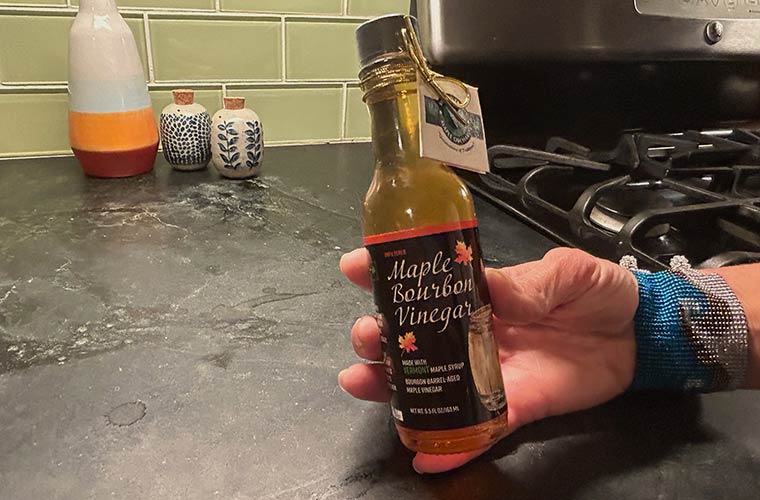
    For six generations, Branon Family Maple Orchards, presently an orchard of 4000+ acres in Fairfield, Vermont, has been tapping its maple trees. About eighteen years ago, Cecile Branon began thinking about how to expand on the maple market. She built a pantry of whipped maple cream, maple sugar, maple jelly, seasonings made with maple, as well bbq and buffalo sauces. Maple vinegar didn’t seem so far-fetched. And it was actually quite sustainable — sort of.

    “When you cook maple, there’s residue [left behind] in the pots. Rather than washing that down the drain, I started heating it back up,” Branon recollects. Branon keeps the solution fairly strong, at a ratio of 1:4, maple to water, adding a small amount  of vinegar mother given to her by her neighbor, Caroline Perley. “I just threw this [vinegar mother] in, and I failed and failed and won!” Branon says. She bought bourbon barrels in which to age her vinegars, most of which stay in there for more than 9 months.  Today, she makes enough vinegar to replenish her 100 gallons of barrels annually, but admits that it’s still trial and error; “even now, I can still fail — a barrel might not take, it happens.”

    In 2018, Branon’s son Justin, started to put some of the maple vinegar to use as the  backbone of a non-alcoholic drink he calls Woodnose Sacré, a blend of coffee, bourbon barrel-aged maple vinegar, maple syrup, spice and botanicals, which was named one of the top NA drinks by the New York Times.

    On a much smaller scale, Ashley Ruprecht and Jeffrey Schad, husband-and-wife team behind Laurel & Ash, in Holmes, NY, never anticipated becoming maple producers, yet alone vinegar makers. Upon moving upstate from Brooklyn about a decade ago, these two creatives (ex-Condé Nast Director of Studios, MTV design studio, millinery company) realized that the eight giant trees that lined their driveway were in fact maples — and that many many more trees among the 50-acre property were as well. 

    “My husband is from a farming family, a few generations removed, but they used to make maple syrup for family use,” Ruprecht recalls. For the first couple of years, the couple gave bottles to friends, had sap tapping parties, and by and by, bought a hobby maple evaporator. A bespoke business was born. “We had about 110 trees and sold out of syrup at the farmers markets.”

    “We still have full-time jobs, so this is a side thing, a big side thing,” she says. This year’s warm weather made for an early run of sap that caught them slightly off guard. But even with 2000 taps this year, Ruprecht says it’s still manageable. Last year, the couple expanded their line and launched a maple vinegar. Rather than just fermenting straight maple, by scarcity and design, they blend apple cider vinegar with maple syrup. The apple juice comes from Salinger’s Orchards, about 20 minutes down the road. Ruprecht and Schad turn it into ACV with the addition of champagne yeast and have begun experimenting with spontaneous fermentation. 

    The biggest contention between Ruprecht and her husband is, ”I love maple but don’t like sweet things [like he does]! I love acid, [so we decided to] make it [maple vinegar] a little sweet, like balsamic — literally a ‘sweet spot’.” Adding to that equilibrium, they’re planning a pancake mix — using their maple vinegar to coddle milk, adding a little bit more sweetness into the mix.

    Even non-maple makers are tapping into the world of maple vinegar. For the last handful of years, Brad Messier, of West Maquoit Vinegar Works, in Brunswick, Maine, has been buying syrup from Sawyer’s Maple Farm, way up in western part of the state. He ferments their dark dank syrup into a strong maple wine, aging it in oak barrels even before a secondary fermentation. Messier developed his maple vinegar from a culinary perspective – always working with recipes in mind. One application is in a whole grain mustard vinaigrette, with scallions, and a touch of maple syrup vinegar — the latter providing brightness, body and depth one might look for in a salad dressing. Miso marinades for salmon have been another tasty application for the maple vinegar, using it to balance typically sweet sauces in the place of mirin (Japanese cooking wine). Messier also professes his love of a sweet-and-sour maple vinegar gastrique to top his French toast — part of a well-balanced breakfast, a sweet tart way to start the day!

    More maple vinegars to try:

    Brigham Hill Maple maple vinegar (Vermont)

    Vermont Vinegars’ red wine vinegar with maple

    Noble Tonic 03: Maple Matured Sherry Bourbon Oak Vinegar


    Originally published on The Vinegar Professor.

  • Maple- and Coffee-Based Sacré Sets the Nonalcoholic Beverage World Abuzz

    Maple- and Coffee-Based Sacré Sets the Nonalcoholic Beverage World Abuzz

    Alcohol sales spiked when the pandemic hit in 2020, garnering publicity from the press and concern from public health officials. While demand for beer, wine and spirits has waned since then, sales of their nonalcoholic counterparts is growing exponentially.

    In the year that ended on January 29, U.S. alcohol retail sales dropped by 4 percent, but sales of nonalcoholic adult beverages rose by 27 percent, according to data analytics firm NielsenIQ. The gap was even wider in Vermont, where alcohol sales dipped by 6 percent and nonalcohol sales jumped by a whopping 49 percent.

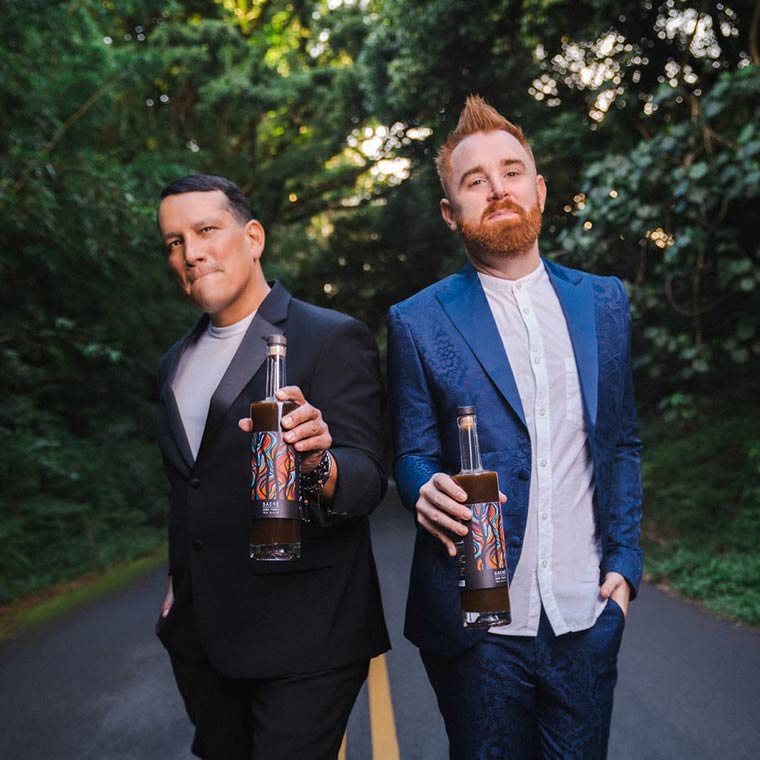
    Surfing the wave are Justin and Roger Branon Rodriguez, the married team who created Sacré, a maple- and coffee-based nonalcoholic spirit produced at Justin’s family’s sugar farm in Fairfield. Designed to be chilled, shaken and sipped as is, the zingy, earthy, aromatic elixir first released in 2019 defies expectations. It’s maple but not sweet, a zero-proof drink generating a 100-proof buzz.

    In 2020, Rachael Ray In Season named Sacré one of four new alcohol-free spirits “shaking up the mocktail world.” In 2021, it won a gold medal in the L.A. Spirits Awards, and the New York Times product review website, Wirecutter proclaimed it one of the best nonalcoholic drinks.

    “We’ve truly never tasted anything like this,” Wirecutter wrote. “Taking a small sip is like throwing back a tequila shot or diving into a freezing pool: It’s a full-body experience, a shock, a thrill, something you want to never do again and yet can’t get enough of.”

    Reviewers can’t seem to agree on exactly what Sacré is. An aperitif? A digestif? Retailers sometimes ask in what section they should shelve it. “It’s somewhere between an amaro and Kahlúa,” says online site Master of Mocktails, “or between unsweetened iced coffee and balsamic vinegar.”

    Justin and Roger call it mysterious. Suzan Eraslan, a mixologist of nonalcoholic beverages, took that one step further: “It’s not just mysterious,” she wrote in her e-newsletter 5PM Eternal, “it’s sorcery.”

    Sacré’s birth story, like its flavor profile, is complex. And, like many a good cocktail, it comes with a twist.

    Roger had married into the Branon family, a clan of doers and inventors. Their farm, Branon Family Maple Orchards, is a veritable maple makerspace. With the exception of pouring the concrete, the family built their 11,000-square-foot sugarhouse and the shop across the drive.

    Justin’s mom, Cecile Branon, has developed an entire line of maple products: sauces, sprinkles, rubs, jelly and vinegars. Her youngest son, Evan, invented Precision Tapper, a device that stabilizes a drill so that it creates a perfectly round hole, which allows for a tighter seal around a tap, boosting syrup production.

    “I was like, Well, I want to make something,” Roger said.

    He started to experiment with making acerglyn, a mead made with maple syrup and honey. The Branon family owns 4,800 acres, taps 94,000 trees and produces more than 50,000 gallons of organic syrup in an average year. “I thought, Well, you know, we can ruin a couple gallons of syrup and it’s not going to hurt us too badly,” Roger said.

    He picked up a carboy and got started. “I put in some orange rinds. I put in some cinnamon — you know, all the stuff that would go into a mead — and started to age it. And I posted about it online.”

    Justin’s cousin Lisa Witzke informed her friend Niki Mohrlant about it because Mohrlant was a consultant for Distill Ventures. The London-based “drinks accelerator” that supports entrepreneurs in creating spirits was running a contest. The company would select five nonalcoholic beverages, work for a year with those makers to refine their products and then award the creators of one drink a monetary prize.

    In addition to acerglyn, Roger was experimenting with drinks made from the maple vinegar Justin’s mother produces. When she ran out of it, she offered them her bourbon-barrel-aged maple vinegar. When they tried it, Roger said, “We were like, Whoa, this is it. This is going to be the base for our drink.”

    Canning jars covered the kitchen island in their Bakersfield home as they experimented. They adjusted syrup and vinegar ratios, tried adding different spices and took copious notes.

    “Nothing really kind of hit,” Roger said. “And then we went to a cousin’s wedding.” (Justin has many cousins. “My family reunions are, like, 500 people,” he said.) His cousin Emily Haddad’s family owns a coffee shop, so her wedding-guest favors included a bag of coffee.

    The Distill Ventures contest deadline was approaching. “We just happened to have this coffee on the counter next to this maple vinegar,” Roger said. “And I thought, Well, what happens if you do this?” — that is, combine them. “And that was the start of Sacré. It was kind of a happy accident.”

    Here’s the twist. The maple-coffee drink wasn’t the one they intended to submit; they thought that another beverage they’d made was better but threw in the coffee concoction because it was there.

    The judges “weren’t crazy about my original submission,” Roger said. “But when they tried the coffee one … they said it literally stopped the show. The founder of Distill Ventures stood up, and he held the sample in his hand and said, ‘Who made this?’ And we immediately won the bursary.”

    Justin and Roger used the $12,000 prize to buy an industrial coffee grinder, a mixing tank, and bottles and labels for their first run. They also spent a large portion of the money shipping samples to London, where consultants helped them refine their drink, remove some of its sweetness and achieve a better balance. The final product contains five ingredients: aged maple vinegar, maple syrup, coffee, and two secret ones — a spice and a botanical.

    Why name the product Sacré? Because Justin had grown up learning that maple syrup was a “sacred liquid” that helped Native Americans survive harsh winters. Syrup freezes at a lower temperature than water does, he explained, so it provided a vital sugar source. The couple’s company name, Woodnose, is a nod to a fable about the woodpecker teaching people to tap maple trees.

    With 100 bottles produced, Justin and Roger headed to New York to launch Sacré in 2019. They’d heard that a new nonalcoholic bar called Getaway had opened in Brooklyn, so they dropped off a bottle. Sometime later, Derek Brown walked into the bar and tried it. The founder of former Washington, D.C., cocktail bar the Columbia Room and author of Spirits, Sugar, Water, Bitters: How the Cocktail Conquered the World, Brown started selling Sacré. (The Columbia Room recently closed.) He keeps a bottle at home, too.

    “I like it on the rocks,” Brown told Seven Days. He also puts it in cocktails, mixing it with lemon and simple syrup. “It can also kind of make a funky espresso martini,” he added.

    Sacré has a bite, a piquancy, Brown observed, “and that’s what I think works best about it.” But it also has sweetness and bitterness. “These are all characteristics of a good adult, sophisticated beverage.”

    Brown mentions Sacré in his latest book, Mindful Mixology: A Comprehensive Guide to No- and Low-Alcohol Cocktails, released in January.

    Neither Justin nor Roger set out to make spirits. Justin, 34, studied fashion merchandise and marketing and lived in Boston and Los Angeles before returning to Vermont. Roger, 51, planned a career in the U.S. Air Force but was forced out under the military’s “Don’t Ask, Don’t Tell” policy. He moved to Lake Placid, N.Y., and studied computer science and graphic design before moving to Burlington in 2000 for a computer programming job.

    The couple met through a dating app in 2011. They may seem like an unlikely pair. Justin, son of a fifth-generation Vermont farmer, grew up feeding cows, cleaning stalls and riding on the back of a horse-drawn sled into the woods to help collect sap. Roger, son of a 25-year Air Force veteran, grew up on Hickam Air Force Base on Pearl Harbor in Hawaii and spent two of his middle school years in South Korea. He helped around the house, sang in the Honolulu Boy Choir and poured Mrs. Butterworth’s on his pancakes.

    “And so he took a chance on me, and I took a chance on him,” Roger said. “We had our first date at the Daily Planet. Went there for a glass of wine, and we just really hit it off.”

    The pair bought a farmhouse on 22 acres in Bakersfield and married in 2015. Justin worked for wine distributor Artisanal Cellars and Roger worked as a UX (user experience) designer.

    Last August, they sold everything and moved to Hawaii. Roger wanted to show Justin where he grew up. And they’ve begun working on a new drink — a Hawaiian spin on a maple-based beverage.

    Sacré remains firmly rooted in Vermont; Justin plans to return twice a year to make it. Their next beverage will benefit from all they’ve learned producing the first.

    “It’s all about hitting all those notes in the mouth: the sweet, the sour, the savory,” Justin said, “and then also the mouthfeel, the roundness, the complexity, the acidity that makes your cheeks perk up and makes you want to take that second sip.”

    “But also, we want it to be weird,” Roger added.

    “Yes,” Justin said, “because that’s kind of our thing, you know. We wanted to make maple weird.”

    Correction, March 3, 2022: This article has been corrected to attribute a quote to Rachael Ray In Season.


    Originally published on Seven Days Vermont.
  • Cecile Branon of Branon Family Maple Orchards: 5 Things You Need To Create a Successful Food Line or Specialty Food

    Cecile Branon of Branon Family Maple Orchards: 5 Things You Need To Create a Successful Food Line or Specialty Food

    At Branon Family Maple Orchards there are times when we get caught in the daily grind.

    Sometimes, in the moment, we lose sight of the big picture.

    That’s why we often reflect on this interview in Authority Magazine with Cecile Branon that puts into perspective what it means to run a family-owned business. When it’s a typical day and we’re busy shipping out gallons of Vermont maple syrup to places around the country, it can be easy to stray great nuggets of wisdom shared in this interview conducted late in 2020.

    Some of the highlights include:

    “Think like a farmer,” Cecile said. “Have an attitude to do whatever it takes. We work nights. We work weekends. Customer service is important, so we go out of the way to make sure people buying our products get what they expect. My husband and I came from families that had to learn work hard just to survive and that lesson has certainly stuck.”

    Or this one, where she was asked how she helps make the world a better place.

    “I wake up every day wondering how I can be better — a better wife, better mother, grandmother, business owner, all of it. Tom and I believe what goes around comes around, so we give a lot of time to people who need our help.”

    If you have a few minutes and are looking for some guidance, please take the time to read the full interview below.

    Define your market. Start small. If you do not have a customer basis to introduce your new products to, use family and friends to see if they like your product and its taste. Then define how big you want to be. Seasonal? Year-round? Know what you can handle. Know what you have for capacity of growth, and how quickly you can grow.

    — Cecile Branon

    As a part of our series called “5 Things You Need To Create a Successful Food Line or Specialty Food”, I had the pleasure of interviewing Cecile Branon, co-owner of Branon Family Maple Orchards in Fairfield, VT.

    Cecile, 62, purchased a family dairy farm with her husband, Tom, in northern Vermont in the mid-1980s. As the dairy industry waxed and waned, the Branons invested heavily in their maple sugar woods and produced pure, organic maple syrup. Cecile expanded the offerings with maple cream and jelly, selling those products at the farm, then moved on to perfecting grilling sauces and seasonings. The Branons now tap nearly 90,000 trees on more than 4,000 acres, and her specialty food line sells direct to consumers online and at select retailers around the country.

    Thank you so much for doing this with us! Before we dive in, our readers would love to learn a bit more about you. Can you tell us a bit about your “childhood backstory”?

    I was raised in a French-Canadian farm family in St. Albans, VT. My mother was born in a northern Vermont house that was located half in the U.S. and half in Canada. My father was Canadian, but his family purchased a farm in the U.S. and moved and raised the family here. After he returned from World War II, he married my mother, purchased the farm from his father and was a dairy farmer until he died. I was 6 at the time of his death. We were three girls growing up, and I was the youngest. We did not have to be taught how to do chores around the house because it was simply expected. I was always working jobs growing up, and after I graduated high school, I became the first person in my family to go to college.

    Can you share with us the story of the “ah ha” moment that led to the creation of the food brand you are leading?

    I married Tom in 1979 and he was from a large Irish-Catholic dairy farm family that also produced maple syrup the traditional manner with buckets, horse-drawn sleds and wood-fired evaporators. We purchased one of his family’s farms in 1984, but over the years pivoted more toward maple. I started learning how to cook with maple syrup and was intrigued. I found some mentors, local women, that I meet at county fairs to teach me. There were always maple cooking contest that I would try to take part in, mostly with the pure maple recipes. After many years of cooking the basic maple products, I set out one day wanting to make a maple marinade. My thought was to use as many all-natural products as possible. Mixing and mingling spices with the maple I found there was a delicate balance when cooking the ingredients because the flavor would change as they simmered together. I made a batch that came out more like a barbeque sauce than a marinade. We slathered it on chicken and it was surprisingly good. I can still remember the taste of that chicken, sweet but tangy, and I knew right then that while I failed making a marinade, I’d come up with a really good maple barbecue sauce.

    Can you share a story about the funniest mistake you made when you were first starting? Can you tell us what lesson you learned from that?

    I’ve certainly had more mistakes than successes. But if you don’t fail, you will never succeed. Part of my mistakes are because my star ingredient, maple, can be tricky to work with. My biggest mistake: I was trying to make maple sugar and I used syrup that was produced late in the season, and the invert sugar (that means the syrup does not crystalize) was off. I ended up with gallons of this sweet goop, the consistency of peanut butter, that I couldn’t do much with. I asked my mentors who cooked with maple for years why that happened, and they helped me understand some of the special properties of maple and how they can change.

    Out of that, there were two lessons. The first is the need to really understand the properties and personality of the ingredients you are working with. You need to be intimately familiar with the particulars of how the characteristics can differ. The second is to reach out to people who understand more about what you’re trying to do, particularly people with a lot more experience. They can help you gain a much deeper knowledge and talk you through your misfires.

    What are the most common mistakes you have seen people make when they start a food line? What can be done to avoid those errors?

    From my farming background comes a practice of really knowing and understanding where your food comes from. To me, the launch of a new product or a new line must be rooted in this sense of understanding and having absolute fluency of the food you are making. When you need to deliver a consistent taste week after week, year after year, it becomes even more important to know backward and forward about all the ingredients you’re using. Things like how they interact with each other, how long they can be stored, what happens if your supply or supplier changes — all of that is important. Those small details make all the difference. You can’t overlook them.

    Let’s imagine that someone reading this interview has an idea for a product that they would like to produce. What are the first few steps that you would recommend that they take?

    Take your time and do the research. I still spend hours looking through old and new cookbooks to understand how maple has been used historically in recipes. When I’m thinking about a new product, I look around to see if anybody else is doing it, and if so, how can I do it differently. I’m always looking at recipes, how a certain product has been made by others and how I can take those ideas and transform them into something new with maple syrup as the sweetener. We just came out with a new product, Maple-to-Go! and it is just a new, smaller, more mobile container that’s different than what anybody else in the maple industry is doing. It took some time to research it and figure out what our unique approach was going to be, but that was key.

    Many people have good ideas all the time. But some people seem to struggle in taking a good idea and translating it into an actual business. How would you encourage someone to overcome this hurdle?

    We just went through this! In retrospect, we’ve had way too many great ideas we didn’t act upon and then we saw somebody else come out with the same product a few years later. The last product we’re working on is an idea we came up with five years ago, and the lesson there is “don’t give up.” Beyond that, is the ability to come to terms with what you don’t know. If you hit a dead end or you hit a stumbling block, look for the right person to help get you over it. Networking can pay huge dividends and it’s a tool we don’t use nearly enough.

    There are many invention development consultants. Would you recommend that a person with a new idea hire such a consultant, or should they try to strike out on their own?

    In one word: Depends. We have not used invention consultants because of the product we’re producing, but our son invented a tool to tap maple trees with, and he used an engineering company to help achieve what he was trying to accomplish. He had the concept but needed to get some help in product development once he got out of the concept stage, so the use of the consultant was extremely helpful.

    What are your thoughts about bootstrapping vs looking for venture capital? What is the best way to decide if you should do either one?

    Essentially, we have always bootstrapped on all our products. We started small, put the product out there, established a base line and tested the market. But our growth has always been a result of our own investment. The other factor that plays in our space are really defining specific growth goals. I cannot make enough Maple Barbecue & Grilling Sauce or Maple Buffalo Sauce to sell to a world-wide market. It is a specialty food product, handmade in small batches, so for us working with a specialty food line we have to establish reasonable sales goals. Sure, we have needed an infusion of cash to grow slowly and smartly over the years, but that came through traditional financing sources.

    Can you share thoughts from your experience about how to file a patent, how to source good raw ingredients, how to source a good manufacturer, and how to find a retailer or distributor?

    It starts with finding a good patent attorney to help you. A good patent attorney is somebody who has a track record of filing patents previously and had success.

    Are you making the product yourself? Or are you hiring a specialty cook to make it for you? We’re lucky because we source all of our own maple from trees on our own land. If you do not have the space to make your product in your home consider a specialty food space, an incubator kitchen or food venture kitchen where you can rent space to make your product. There, you can usually find help with sourcing ingredients, packing, shelf life, that kind of thing. Connections to retailers and distributors in those shared maker spaces may also be available. Again, speaking with someone that has more experience to help you find your way. In Vermont, we also have a Specialty Food Association which is a valuable resource for putting you in contact with many resources.

    Here is the main question of our discussion. What are your “5 Things You Need To Create a Successful Food Line or Specialty Food” and why? (Please share a story or example for each.)

    1. Have a love and understanding for your product, we love maple syrup, we love the different products maple syrup can make — maple cream, candy, sugar, and we are able to use it in any form. We understand our product and make use of its value.
    2. Listen to what customers are looking for. I don’t like spicy foods, but one of the best-selling products we make is our maple buffalo sauce. That was a product our customers were asking for, something spicy and sweet. That was a lesson also applied on our new Maple to Go! Re-closable pouch. Our customers were looking for a way to carry maple syrup with them to restaurants, camping and for travel sports. We found a way to make that happen.
    3. Define your market. Start small. If you do not have a customer basis to introduce your new products to, use family and friends to see if they like your product and its taste. Then define how big you want to be. Seasonal? Year-round? Know what you can handle. Know what you have for capacity of growth, and how quickly you can grow.
    4. In specialty foods: Keep it real. Think about how the world looks at food. We may have to charge a higher price, but the reason for that is our food is healthy, organic, and natural. We use as few ingredients as possible with the understanding that customers will pay a premium for good food.
    5. Think like a farmer. Have an attitude to do whatever it takes. We work nights. We work weekends. Customer service is important, so we go out of the way to make sure people buying our products get what they expect. My husband and I came from families that had to learn work hard just to survive and that lesson has certainly stuck.

    Can you share your ideas about how to create a product that people really love and are ‘crazy about’?

    One word: Listen! What are people wanting? What do people always tell you they wish you made? What are the markets looking for? Finally, can you meet the needs of those requests from your clients? Example: We make a Maple Kettle Corn, and it sells really well. I knew people were wild about kettle corn but I did not like the traditional recipe. We had customers requesting this maple option, so I found a way to make it with just natural ingredients which, to us, makes it a better product.

    Ok. We are nearly done. Here are our final questions. How have you used your success to make the world a better place?

    I have a difficult time saying I’m successful. I wake up every day wondering how I can be better — a better wife, better mother, grandmother, business owner, all of it. Tom and I believe what goes around comes around, so we give a lot of time to people who need our help. I have been an advocate for the maple industry in this part of the world, trying to keep the stoke and appreciation for maple as high as possible. I do not use a financial yardstick as measure of success, I look at the people I have helped or who have benefitted from my efforts.

    You are an inspiration to a great many people. If you could inspire a movement that would bring the most amount of good to the most amount of people, what would that be? You never know what your idea can trigger.

    Be good to people! You have no idea what others are going through, so try not to be judgmental. Embrace the simple things in life. We’re all way too caught up in the hustle and bustle around us that we’ve been told are important. Take a walk in the woods and listen to the birds sing. Play a game of checkers. Grow a garden. Be mindful. Have pride and take care of what you have.

    We are very blessed that some of the biggest names in Business, VC funding, Sports, and Entertainment read this column. Is there a person in the world, or in the US, with whom you would love to have a private breakfast or lunch, and why? He or she might just see this if we tag them.

    I thought about this for some time, and kept coming up with one person: Dolly Parton. She built an empire on her will and might, despite being told multiple times it couldn’t happen. She has a truly kind and generous soul. I have true respect for her. Maybe it is because she emerged as a successful businesswoman in a traditional male-dominated world, or maybe it’s because we appreciate the country life.

    Thank you for these fantastic insights. We greatly appreciate the time you spent on this.


    Originally published on Authority Magazine.

  • Branon Family Maple Orchards: Conserving Working Forests Through Ongoing Partnership

    Branon Family Maple Orchards: Conserving Working Forests Through Ongoing Partnership

    The ownership, economics, and composition of Vermont’s forestlands have changed over the past fifty years. Through these changes, the Vermont Land Trust has partnered with landowners. One method of partnership has been land acquisition: in 1997, The Vermont Land Trust (VLT) and the Nature Conservancy of Vermont (TNC), with the support of the Freeman Foundation, partnered to purchase 26,789 acres of actively managed forestland from the Atlas Plywood Company.

    VLT and TNC formed the Atlas Timberlands Partnership (“The Partnership”) in order to illustrate how land conservation organizations can work together to achieve shared goals. Through the process, they have each influenced how the other works. In their approach, the Partnership sought to balance the three points of their mission – ecology, economy, and community – with the goal of managing timberland as a natural resource. In practice this has meant ongoing, high quality forest management across the land with an emphasis on restoration of species and age-class diversity in the forest, the preservation of habitat, long-term relationships with local loggers, and maintaining public access.  The partnership has coincided with an economic shift in the North Woods as local timber markets have declined. In the 20 years since the original purchase, maple sugaring has joined timber as one of the key economic products of forestland.

    Recently, the Partnership has begun the process of conserving and selling parcels from the Atlas Timberlands ownership. They will use the proceeds to protect more forestland in Vermont. In 2016, VLT and TNC sold a 2,080 acre parcel in Bakersfield from the Atlas Timberlands Partnership to Tom and Cecile Branon. The story of this purchase and the goals of the new owners illustrate an ongoing transition in how Vermont uses and relates to its forests, and the role of conservation organizations like VLT in that evolution.

    The Branons have been shaped by their personal connection to the Vermont landscape. Tom, Cecile, and their children are part of a fifth-generation dairy family from Franklin County, and had previously protected their 653-acre Fairfield dairy with VLT. Having invested in the family’s dairy farm and maple-sugaring operation more than thirty years ago, they sold off their cattle in 2004 to focus on maple production.

    The Branons operate Branon Family Maple Orchards, which sells everything from jugs of syrup to value-added specialties like maple-barbecue sauce. The Branons’ job site is their backyard: their land now extends over 3,200 acres in the Cold Hollow Mountains and is part of a key wildlife corridor.  VLT and TNC’s values aligned well with those of the Branons, a family with a strong commitment to making their living from the land with careful attention to stewardship. Expanding onto this affordable parcel of high-quality forestland enabled the Branons to grow their sugaring operation while also stewarding the forest resource.

    VLT, TNC, and the Branons negotiated a conservation easement on the 2,000-acre parcel as part of the family’s purchase. The easement limits development of the property and in other ways requires the owner to manage the land in a manner that will maintain and enhance its ecological values. VLT is the holder of the conservation easement, and will steward it in perpetuity.  That means VLT conservation values will endure over time.

    The easement included special stipulations which protect the species diversity, climate resilience, and wildlife values of this property. The Partnership negotiated the easement in consultation with the Branons’ current uses of this land, and with flexibility to shift uses through time. Their agreement reflects up-to-date best practices in forest management, ecological stewardship, and public access. The Partnership was able to look past the existing uses of the parcel and see how it might be economically viable into the future.

    The Branons closed on the parcel in Bakersfield on June 9, 2016. They were eager to get to work in the forest: “I can tell you, we were up on the property pouring concrete for the bridges that afternoon,” said Tom Branon. The Branons are aiming for twenty to thirty thousand new taps by the beginning of the winter in 2017.

    The forest will keep the Branons busy. Each sugaring season is technically over around the end of April, after the Branons pull out the taps from their trees. But the work of running a maple sugaring operation, Tom explains, isn’t finished then. They must clean all the equipment and repair anything in the current infrastructure in preparation for the next season. Then, before any new taps can go in, the Branons and their employees work on putting in new roads, scouting for new trees and maple stands, and upgrading their infrastructure so that the operation can continue to thrive.

    In conserving the Branon parcel, both the Partnership and the family recognized they needed to take great care: while a conservation easement is perpetual, and will forever be attached to the land, it must also be able to support different land uses through time. VLT and TNC negotiated the conservation easement with stipulations to protect natural resource values while also considering the pressure landowners face in a changing economy. With the Branon easement, the Partnership identified the land resource values that need to be protected forever. Mindful of these protections, they designed an easement that will be adaptable to different economic models and uses. The Partnership has helped the Branon family make their living from the land in ecologically sustainable ways. For the Branons, working with the Partnership became a matter of working through details rather than a fight over principles or a compromising of ideals.

    The Branons’ outlook on ecological sustainability in their sugarbush could be seen as a model for other landowners. Tom and Cecile saw the rigorous ecological protection standards of the easement as parallel to their goal of keeping the forestland in the family for generations to come. If you aren’t looking at the biological health of your land, Tom argues, you have failed to look out for your children and grandchildren. For the Branons, sustainability is about possibilities, not limitation. Thinking about sustainability means thinking about how their land can be profitable for a long time.  Tom believes ecological sustainability is a family principle as much as it is a core concept of conservation ecology.

    When we asked Cecile and Tom what they missed most about life as dairy farmers, they talked about the moral and financial stability that came from the routine of animal husbandry. Without the twice-daily routine of milking, the Branons had to develop a work ethic that did not come from the necessities of dairy farming. The cash flow that used to come from supplying milk to St. Albans Co-operative Creamery became less consistent. All the same, Tom acknowledged that the transition was a smart move, since they made the choice to move from dairy to maple around the time milk prices began to decline and maple-sugar values steadily increased. As the years have gone on and the Branons have forged a deeper connection with their sugarbush, the loss of the cows has given way to the positive associations the family has with their forest. Cecile often mentions that the woods are Tom’s favorite place to be. When asked whether that’s true, Tom cracked a big smile. “That’s right,” he said. There’s nothing he’d rather be doing than making syrup.


    Originally published on High Meadows Fund.

  • It’s Boom Time for this Vermont Sugar-Making Business

    It’s Boom Time for this Vermont Sugar-Making Business

    After exiting dairy, the Branon family built one of Vermont’s largest maple sugar production and retailing operations.

    Vermont’s maple industry has been booming and rapidly changing over the past few years. But few sugar-making operations have changed like the Branon Family Maple Orchards has since 2001.

    Faced with changing to keep up with a shifting dairy industry, Tom and Cecile Branon sold their dairy herd that year. Then they sold feed and drove truck, along with sugaring on their 700-acre home farm at Fairfield, Vt. “Back then, no one was living off sugaring; it was just a diversification,” recalls Cecile. Not for long.

    Today, the Branons and sons Kyle, Shane and Evan sugar full time. Their fourth son, Justin, also pitches in.

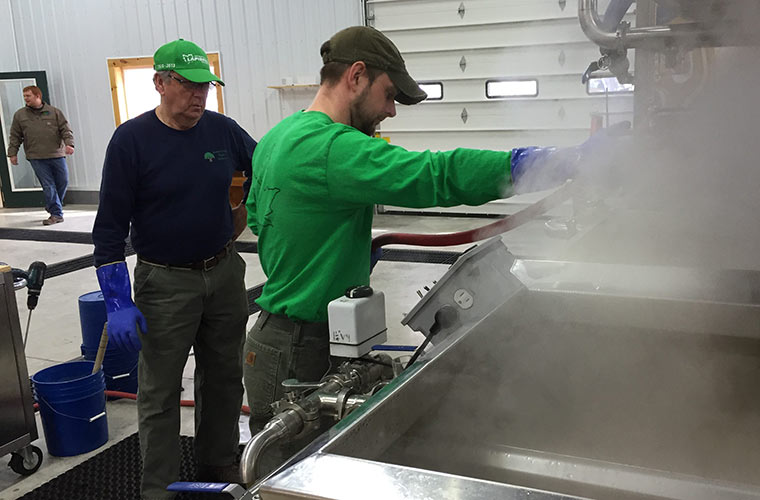
    In 2013, they replaced their home farm’s sugarhouse with a 10,000-square-foot building housing two 6-by-16-foot evaporators and equipment, a kitchen, sales area and storage. They also added solar panels.

    The Branons set up tubing systems and pump houses on 1,300 acres purchased in neighboring Bakersfield. Last year, they bought another 2,000-acre parcel in Bakersfield from the Vermont Land Trust and The Nature Conservancy. By July, the family was racing to build a new pump house, install three 8,000-gallon sap tanks and add 15,000 more taps on the new property — an investment of more than a $500,000.

    Crazy Busy Sugaring Season

    This winter, sap will be running from 78,000 taps. With taps up to 18 miles from the home farm, a half-dozen people walk the sap lines checking for animal damage, icing and downed trees on any given day. Two more are boiling sap. Several others are hauling sap tanks from gathering tanks and pump houses.

    Each of three pump houses has a white board listing each tubing system and line by name and number. Cameras allow monitoring the reverse osmosis machines, storage tanks and vacuum systems at each pump house from the home farm.

    Via the ROs, sap is concentrated to 7% to 10% sugar. Then concentrate is trucked to the Fairfield sugarhouse and further concentrated before it’s boiled down in an evaporator.

    About 80% of their core mainlines are buried, for good reason. As the climate warms, underground lines will keep sap cooler and extend the sugaring season.

    Their new sugarbush adds one big advantage — higher altitude and colder temperatures. “The season in Bakersfield is 10 to15 days longer than Fairfield,” points out Cecile. “When you’re starting to make commercial grade in Fairfield, you’re still making table grade up there.”

    The Branons take good care of their maple trees — only one tap per tree that must be at least 10 inches in diameter to be tapped. Each year, 10,000 taps are rotated out of production for a year to rest the trees, and give them time to clean and trim out undergrowth.

    Back at the Sugarhouse

    About 6,000 gallons of syrup a year goes into Cecile’s maple cream, barbecue sauce, vinegar, kettle corn and other products. The rest is sold in bulk.

    Branon Family Maple Orchards is certified organic and kosher. Its sugarhouse was one of the first to be certified by the state of Vermont for good management practices.

    “If you’re going to be a leader in the industry, you need to set an example and have a clean, quality facility and a good image,” emphasizes Tom Branon. “We need to step forward and show people that.

    “We also need everyone to do the certification, and the entire maple industry will benefit.” With consumers attracted to maple’s health benefits, it’s perfectly placed to substitute for high-fructose corn syrup in the future, he contends.

    “We love sugaring; it’s in our blood,” sums up Tom. “It’s not just the economics — it’s truly family, neighbors, and friends.”

    Harlow writes from Westminster Station, Vt.

    Sugar-Making, Sales Booming, Especially in Vermont

    During springtime, there isn’t a truck in Franklin County, Vt., without a sap tank on the back, reports Cecile Branon. Even homeowners on 10-acre lots tap backyard trees and sell the sap to the nearest commercial-size sugar-maker. That’s just one indication of how the maple industry has exploded here.

    Vermont is the largest U.S. maple producer, with about 42% of total production. The 2016 maple season was its biggest ever, producing an estimated 1.9 million gallons, adds Henry Marckres, chief of consumer protection for the Vermont Agency of Agriculture.

    In the last 10 years, Vermont tap numbers have leaped from 1 million to 5 million, says the longtime maple expert. In 2016 alone, tap numbers jumped between 300,000 and 500,000.

    It’s not only more taps that’s adding to production. “Years ago, we used to figure one quart [of syrup] per tap,” says Marckres. “Now, with all the new technology, smaller taps and high vacuum, most people today aren’t satisfied unless they get a half-gallon per tap.”

    With Canada, the world’s largest maple producer, loosening quota for its producers, is there enough demand for all that maple syrup? “It’s amazed me,” he marvels. “It used to be there would be a sharp drop in price; the demand wouldn’t be there. But we just haven’t seen it. Demand has tripled, and we’re selling to all countries.”


    Originally published on American Agriculturist.

  • Talking 50th Vermont Maple Festival

    Talking 50th Vermont Maple Festival

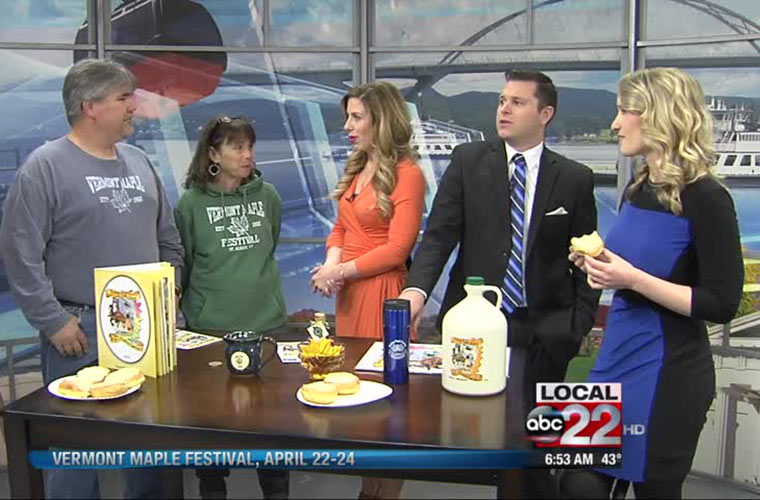
    Vermont Maple Festival co-chairs Stephen Tetreault and Cecile Branon visit Local 22 & Local 44 News This Morning to tell us what’s happening at the 50th Vermont Maple Festival this weekend in St. Albans.


    Originally published on My Champlain Valley.

  • Grossman School of Business Honors Family Businesses at 4th Annual Awards Ceremony

    Grossman School of Business Honors Family Businesses at 4th Annual Awards Ceremony

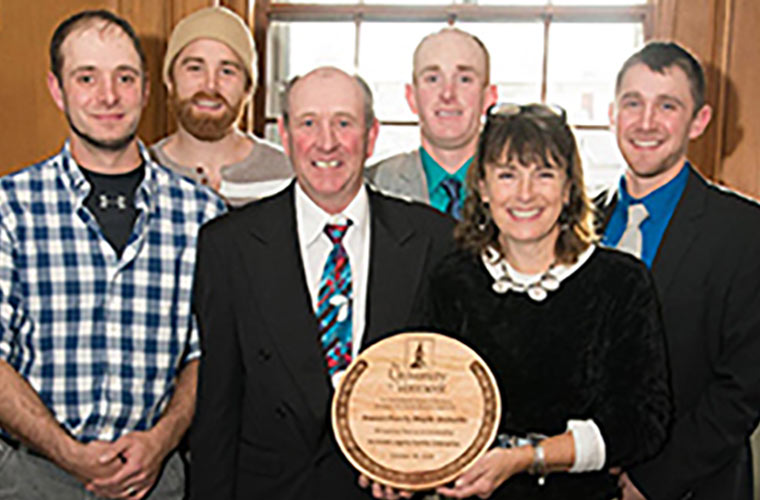
    The Grossman School of Business honored four family businesses for excellence in the areas of entrepreneurship, innovation and sustainability at the UVM Family Business Awards on Oct. 30 in Waterman’s Memorial Lounge.

    This year’s honorees, recognized for their ability to overcome challenging succession issues and for contributions to community and industry, included a winery, a maple orchard, a garnet mining company and the leading provider of digital grocery services in the country. 

    “You have provided meaningful value to society and the economy, and you inspire us all,” Promodita Sharma, the Daniel Clark Sanders Chair & Professor of Family Business at the Grossman School of Business, told the honorees at an event attended by local business owners, faculty, staff and students.

    The 14 family businesses that have been honored since the inception of the program four years ago have a combined workforce of 6,800 employees, $388 million in sales and 740 years of multi-generational experience. 

    A six-person panel, composed of past winners, alumni, and local business owners, selected Vermont-based businesses or out-of-state businesses run by UVMs alumni based on the following criteria: financial success; governance structures; contributions to the community and industry; and innovative business practices or strategies.

    1st Generation Family Enterprise Award

    MyWebGrocer, launched in 1999 by UVM alumni and brothers Rich, Jerry and Brian Tarrant, was honored for its creation of a grocery eCommerce platform that allows people to order groceries online and have them delivered to their home or business. Today, the company manages digital solutions for more than 130 retailers around the world, representing more than 10,000 stores and 500 major consumer packaged goods brands. MyWebGrocer, which experienced 55 percent growth last fiscal year, employs more than 250 Vermonters, primarily in its Winooski Mill location, and another people 200 worldwide.

    Multi-Generational U.S. Family Enterprise Award

    Boyden Valley Winery, an award-winning producer of wines and cream liqueurs, was opened for business in 1997 on the fourth-generation Boyden family farm by David and Linda Boyden. It would become the first bonded winery in Vermont to grow grapes. The planting of winter hardy varieties allowed them to yield up to four tons per acre and release mjaor products such as their signature wine “Vermont Ice.” In 2010, Boyden became a licensed distillery to position themselves as the only company in the U.S. to specialize in craft distilled crème liqueurs. In 2013, they started producing hard cider.

    Multi-Generational Global Family Enterprise Award

    The Barton Group has produced the world’s highest-quality garnet abrasives for more than five generations. Founded in 1878, the company started with a mine near the summit of Gore Mountain in New York’s Adirondack Park, where it operated for 104 years. In 1982, the operations were moved to neighboring Ruby Mountain, where the company still operates today. The company started by mining and milling garnet for the sandpaper industry, but over the years developed new products, markets and applications, including its current production of garnet abrasive products for multiple applications.

    Vermont Legacy Family Enterprise Award

    Branon Family Maple Orchards of Fairfield, Vermont, has undergone a number of strategic changes during its seven generations of operation. In 1984, Tom and Cecile Brannon purchased a farm owned by Tom’s parents and operated a dairy herd of about 125 cows and 300 acres of pasture, sugar bush and tillable land. In 2004, with unstable milk prices and an aging milking facility, the couple decided to sell their cows and increase their organic maple production. As the business grew into one of the state’s leading organic maple producers, 18 solar trackers were added to save money and create clean and renewable energy to run the facility.


    Originally published on The University of Vermont.

  • The “Heart and Soul” of Sugaring in Vermont

    The “Heart and Soul” of Sugaring in Vermont

    On a thousand acres in Fairfield stand more than 68,000 maple trees tapped for sugaring season.

    FAIRFIELD – Cecile Branon took her first tour of Maple Open House Weekend — the White family of Georgia, Vermont — into the crisp, cold air Saturday morning for a look at a tap and line coming out of a soft maple near the Branon Family Maple Orchards sugarhouse in Fairfield.

    Sugar warehouse, really. The Branon operation, split between Fairfield and Bakersfield, taps 68,000 trees, and that’s down from past years, before a series of storms forced the Branons to take damaged trees offline. The 2013 storm coating trees and vacuum lines with two inches of ice was particularly damaging.

    “It was a disaster,” Cecile Branon said.

    The Branons — Tom and Cecile and three of their four grown boys — couldn’t even get into their woods for almost two weeks, and even then it was dangerous.

    “You could hear everything crashing down,” Cecile Branon said. “We had to cut our way into the woods.”

    The White family — Andy and Carrie and their children, Quin, 6, and Malia, 4 — gathered around the tree near the sugarhouse as Branon explained the beginning of the sugaring process, tapping the tree.

    A few feet up the double trunk of the maple, a single plastic tap penetrated the tree, attached to a 5/16-inch looping vacuum line, clogged with frozen sap. The sap isn’t flowing yet, given the unseasonably cold weather.

    “Yesterday it was supposed to be 42 degrees,” Branon said. “Nothing. We didn’t get a drop. Everything was froze up.”

    What the sugarbush needs, Branon said, is rain and snow combined to get moisture to the roots of the trees and onto the bark, where snow usually clings, and then warm days and cold nights to get the sap flowing.

    “We could lose everything and be done in two weeks,” she said. “It’s Mother Nature.”

    Top county in the top state

    But Branon is not complaining. She tells the Whites, with obvious pride, that Franklin County is the top-producing county for maple syrup in the state, and that Fairfield is one of the top-producing towns. The Branons have been farmers and sugarmakers for seven generations.

    Cecile Branon explains how careful her family is with their trees — tapping only 11-inch diameter trunks and up, using only one tap in even the biggest trees, using new taps every time to keep down the chance of bacteria growing, and making sure old tap holes heal up properly.

    Even with all that care, Branon worries about a deadly threat over which the family has no control — the Asian long-horned beetle.

    “We keep praying we don’t see the insects that will destroy our trees,” Branon said. “It would just destroy everything.”

    Branon’s voice is loud and clear, with the clipped Vermont accent that is a sure sign of a native. She’s a bundle of energy and enthusiasm, so that even her foreboding explanation that a bug could torch decades of hard work seems somehow upbeat. It’s hard to believe it could ever happen.

    Back inside, Branon walks the Whites through a thorough, hour-long tour of the sugaring process, from the sap running into holding tanks through 4-inch lines buried underground, to the massive, stainless steel evaporator in the expansive boiling room where the sugar content in the sap is concentrated to 66 percent. Coming out of the trees, the sap runs at 2 to 3 percent sugar content.

    “You got a long ways to go,” Branon says of getting the sugar content where it needs to be.

    The scale of the Branon operation is perhaps best reflected in the three 20,000-gallon storage tanks, embedded horizontally in the wall of a room with soaring ceilings and only the front few feet of the tanks showing. The tanks, towering perhaps 15 feet high, were purchased years ago from a Labatt brewery in Canada. Branon said she couldn’t afford to buy such tanks nowadays, even if she could find them.

    “These are glass-lined tanks,” Branon said. “It’s very cold and very black in there. We have to crawl in on our bellies. These tanks are washed all the time. This tank was washed last night.”

    Say what?

    The door the Branons use to enter the tanks look like it would be a tight squeeze for 6-year-old Quin White, much less the full-grown Branon boys. And Cecile Branon carries her weight in both the sugarhouse and the sugarbush, where she joins her husband and sons for the hard work of maintaining 68,000 maple trees.

    Big money, big syrup

    Impressive as it is, however, Branon Family Orchards pales in comparison to a new operation in the Northeast Kingdom, Sweetree LLC, which has announced it plans to become the biggest producer of maple syrup in North America.

    Backed by Wood Creek Capital Management, a private equity firm in New Haven, Connecticut, Sweetree bought 7,000 acres of forest land in Warren Gore and Averys Gore in Island Pond, and has already installed 95,000 taps, with plans for 500,000 taps.

    Cecile Branon hopes for the best from this new development in Vermont’s maple syrup industry, but clearly has her doubts.

    “Hopefully it will be positive,” she said. “I understand they’re looking to do more with foods and stuff and that’s good because it’s all value-added.”

    But what Branon worries about is losing the family values that have always characterized the Vermont sugarbush. She and her husband, Tom, looked at the property Wood Creek bought, which was priced at $1.7 million, and passed.

    “People are getting into the industry, but it’s more than just producing a product,” Branon said. “For us it’s your heart and soul, it’s your history, it’s been your life. There’s a lot more to it than, ‘Oh, I’m going to make maple syrup and make some money.’ Making money is hard because it’s a lot of work. I guess if you’ve got a lot of money you don’t really care.”

    Wood Creek Capital Management certainly has a lot of money, with about $2.1 billion under management. Wood Creek is an affiliate of Babson Capital Management LLC with offices in Boston, New York and Charlotte, and more than $212 billion under management.

    “What’s important as we see a lot of growth and people coming into Vermont is that they realize it’s a love to do it,” Branon said of sugarmaking. “It’s a life. It’s a livelihood.”

    Coming to the end of the tour in the barrel storage room, Melia and Quin White have about reached their limit for learning about the maple syrup business. Melia circles the expansive concrete floor as Quin squats down, his sister finally coming over to pat his back.

    But next is the kitchen, with all kinds of maple treats.

    “We’ve got maple popcorn over there and some maple candy, which is all pure maple, and some barbecue sauce,” Branon said. “Help yourself to try everything. If you have questions, holler. We’ll be glad to help you out.”


    Originally published on Burlington Free Press.